

This is the third in a series of posts for National Nutrition Month. If you missed it, check out Part 1: What is Nutrition? and Part 2: Macros — Protein, Carbohydrates, & Fat.
Today, we are diving into the world of micronutrients, understanding why I included many of the foods in my meal-planning template in Part 2, and the growing evidence that “whole” foods provide much more than their isolated parts.
Micronutrients
Micronutrients are underappreciated and misunderstood.
If macronutrients (protein, carbs, and fat) provide the raw materials for the body to function, repair, and build, then micronutrients are the cofactors, aka “workers”, that get stuff done.
The energy from carbohydrates, for example, doesn’t just jump to work as soon as you swallow. After a complicated process of digestion (breaking the carb down into its smallest units) and absorption (the smallest units moving to the bloodstream), an even more complicated metabolic process turns it into energy for the cells:
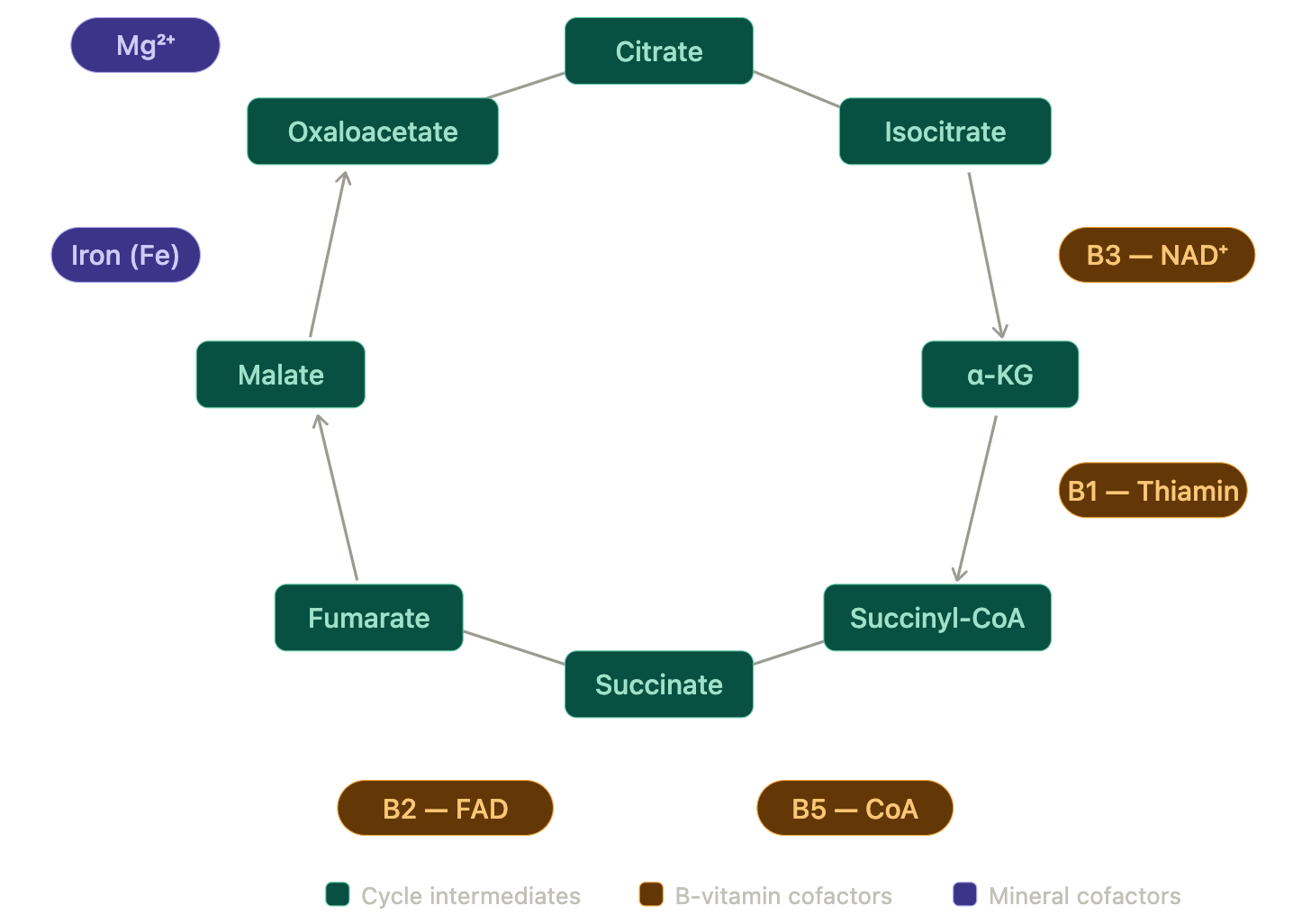
Don’t worry, I won’t test you later. This dizzying diagram demonstrates that Vitamins B1, B2, B3, & B5 (in brown), as well as minerals iron & magnesium (in purple), are essential for carbohydrate metabolism.
Now, consider that this is only one part of carbohydrate metabolism!
Without enough of vitamin and mineral cofactors in this, or any other of the numerous processes that occur throughout the body, your health, energy, and function are impaired.
Inadequate Vitamin B1, for example, can cause a condition called beriberi (very rare in the US), which may cause fatigue, weakness, numbness, heart failure, fluid retention, memory impairment, confusion, irritability, and more.
This condition can be avoided by regularly consuming whole or enriched grains, nuts & seeds, and soy, and avoiding chronic alcohol abuse, which is the main risk factor for this deficiency in the US.
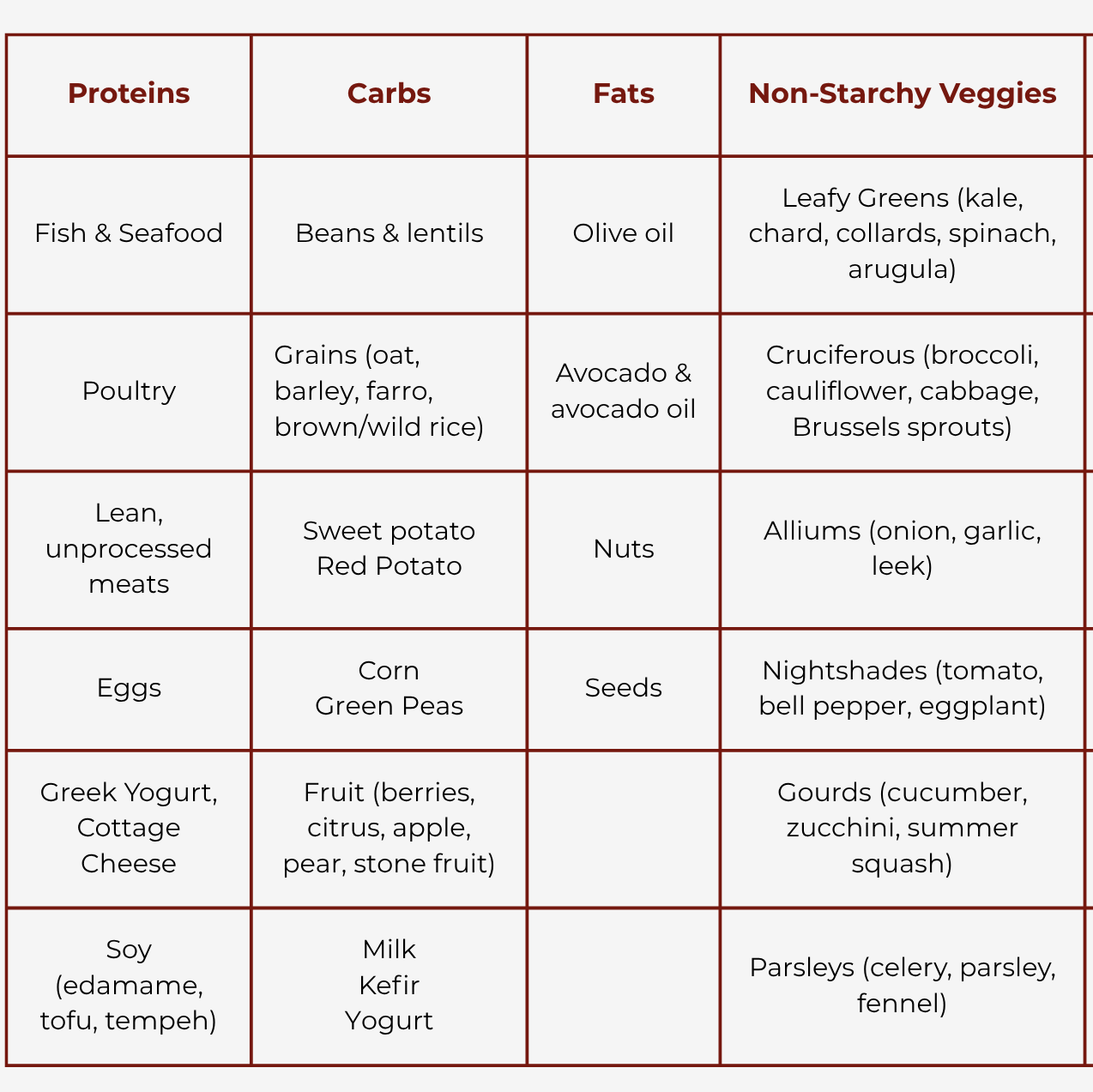
Below are two charts I put together for a recent class. I was trying to show why I included each group of foods on the macronutrient chart shared and discussed in Part 2.1
I don’t want you to just take my word for it that eggs are a good protein source, for example. I hope that the charts below speak for themselves2.
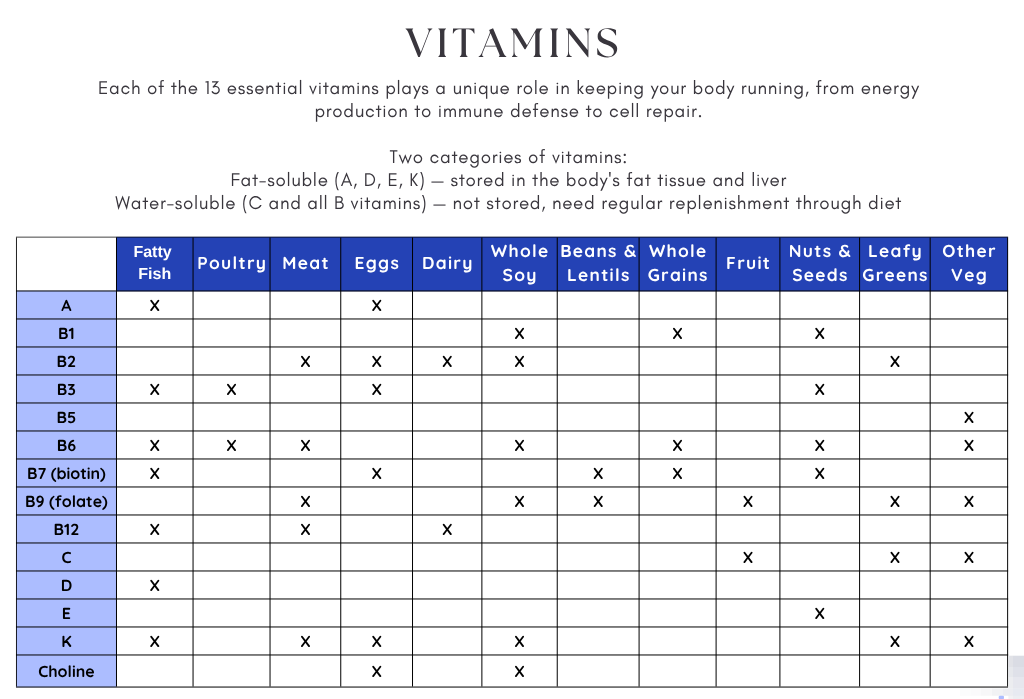
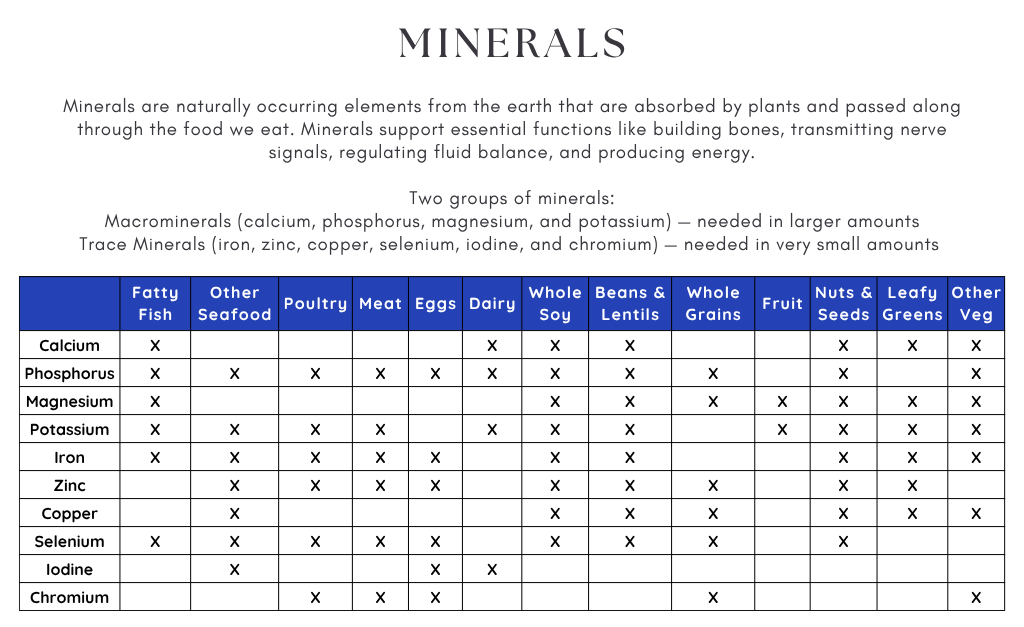
You won’t be tested on these charts, either. Full disclosure, I would probably fail the test, too.
The point is to demonstrate all the good and important factors in each of the included foods.
After looking at this, I hope you can see that nuts & seeds, for example, are more than just trail mix. They are a secret source of more than half of the vitamins and minerals that your body needs to work at its best.
Well, there you have it. This is the end of my 3-part series, where I did my best to sum up the big take-home messages about the field of nutrition.
What was your top takeaway?
Thanks for being here,
~Allison
Please remember that this information is meant to inform and inspire and is not personal health or medical advice. Please speak with your healthcare team about what is right for you.
Please note that these charts are meant to provide a broad illustration of the micronutrient components in different generalized groups of food and are not intended to provide specific recommendations, as amounts of micronutrients vary within each general group provided above.
Additionally, the minerals chart is not a comprehensive list of all identified minerals. A complete list of minerals can be found here.