

Welcome to the 4th and final installment of my 2026 series about cognitive health.
In Part 1, I reviewed what cognitive health is and the most common causes of cognitive decline (Alzheimer’s disease tops the list).
In Part 2, I explained the non-modifiable risk factors for Alzheimer’s disease (age, genetics, and biological sex).
In Part 3, I explored the 14 modifiable risk factors that contribute to up to 45% of all dementia cases, which are things you and your healthcare team can monitor for and address.
Today, I’ll dive into what we know about brain-healthy eating and how dietary patterns can work for, or against, your cognitive health.

Until about a decade ago, we had a hunch that the Mediterranean diet was good for the brain, but we didn’t have much good evidence to be sure.
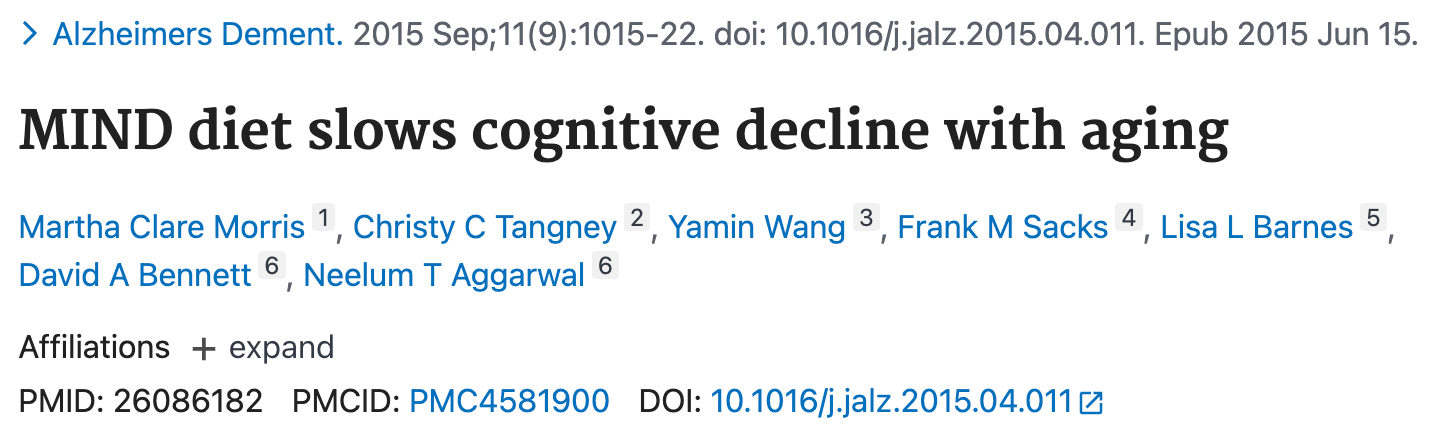
That changed in 2015, when research on the MIND diet first made headlines1. (Note: I prefer “approach” because I’m not a fan of the 4-letter “D” word).
What is the MIND “diet”?
MIND is an acronym (which, it turns out, encompasses another acronym “DASH” which stands for Dietary Approaches to Stop Hypertension):
Mediterranean-DASH
Intervention for
Neurodegenerative
Delay
In short, the MIND intervention combines the cognitive and cardiovascular benefits of Mediterranean eating with the cardiovascular benefits of the DASH plan.
Results of the 2015 study showed that after following 960 people for almost 5 years, those who consumed the recommended MIND foods most of the time showed slower cognitive decline.
In fact, these “most of the time” folks had cognitive function equivalent to being 7.5 years younger in age than those who ate MIND foods the least.
Importantly, perfection was NOT required to see benefit.
This is good news for all of us.
If you can incorporate the MIND foods into your routine a moderate 70-80% of the time, your brain gets the benefits.
Plus, the research doesn’t suggest that you have to give up the foods that you love.
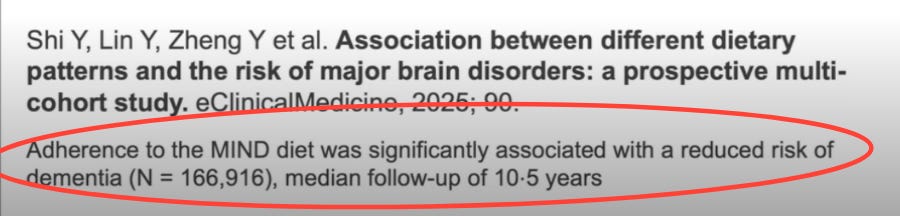
Research from around the world has continued to support the MIND intervention for reducing the risk of dementia:2
MIND Foods
The MIND approach first focuses on foods to consume more regularly (a refreshing change from “diets” that start with what to avoid):
Green leafy vegetables — daily
Other types of vegetables — daily
Berries — 2+ per week
Nuts & Seeds — 5+ per week
Olive oil — daily
Whole grains — daily
Fish — 1+ per week
Beans — 3+ per week
Poultry — 2+ per week
While participants in the MIND studies were also encouraged to decrease intake of butter, cheese, red meat, fried foods, and sweets, the focus on what to consume more of is likely the most important part.
“Neuro” Nutrition:
As you can see, the brain-healthy MIND foods are largely plant-based, meaning that they are rich sources of fiber, vitamins, minerals, and phytochemicals.
These components, along with ones we likely haven’t discovered yet, promote brain health by:
Improving cardiovascular health — blood pressure & cholesterol
Supporting metabolic health — blood sugar & inflammation
Increases micronutrient intake — vitamins and minerals (including B-vitamins, choline, zinc, iron, magnesium, and more)
Supporting neurotransmitter (brain cell) function — healthy proteins
Supporting brain structure — healthy fats
Providing reliable energy for the brain — healthy carbohydrates
Fueling the microbiome — fiber
A note on alcohol
While a glass of wine daily was originally seen as a positive dietary addition in the 2015 MIND publication, we now believe there is no safe level of alcohol consumption for brain health.3
Brain Healthy Eating = Healthy Eating
I often get new patients who come to me in a panic that they need a diet for their diabetes, high blood pressure, and cognitive health.
How will they manage it all!?!
The reassuring news is that brain-healthy eating is healthy eating. The MIND foods aren’t just good for your brain; they are good for your heart, your blood sugar, inflammation, cancer risk, and more.
Once again, the research points us to more plants, including fruits, vegetables, nuts, seeds, and grains.
No magic. Just real food.
Thanks for being here,
~Allison
Remember that this information is meant to educate and inspire, but is not medical advice. Please consult your healthcare team to determine what is most appropriate for you.
Allison,
I’ve found this whole series on cognitive health to be practical, informative and hitting close to home. Really grateful for the resources you are providing! Thank you for this gift to the world. 💜
Allison,
The one MIND food category I don't get is seeds. What beneficial elements do they contain? And how many do you need to eat and/or how often? -/Leslie