


I remember when my grandma’s memory started to falter. I was in grad school.
She would tell me the same stories.
She would ask me the same questions.
She knew something was off.
But, like her doctor at the time, I brushed it off:
“Grandma,” I said, “you need to focus so you don’t forget.”
Now, I feel awful about saying that.
Placing blame on her probably did more harm than good.
It wasn’t a matter of focus at all. It was the first sign of Alzheimer’s disease.
Fast forward 8 years, and, because of one of those situations of being in the right place at the right time, I had the opportunity to work with a program for the Buck Institute for Research on Aging, which is just over the hill from where I live.
At the time, research was emerging that suggested that much of one’s risk for Alzheimer’s Disease is modifiable.
So I dove into the literature, and sure enough, there was hope after all.
I had the honor of developing a nutrition education curriculum and working one-on-one with patients and providers to use lifestyle (including nutrition) approaches to support their cognitive function.
The research and the hope have continued to grow. Alzheimer’s disease isn’t inevitable. Modifiable risk factors (meaning, things you can do something about) make up an estimated 45% of the risk for developing Alzheimer’s disease.
That isn’t a small number.
What is cognitive health?
Cognitive health is the ability to think clearly, learn, remember, and make decisions that support independent daily life and overall well-being. It encompasses several interconnected domains of brain function, including:
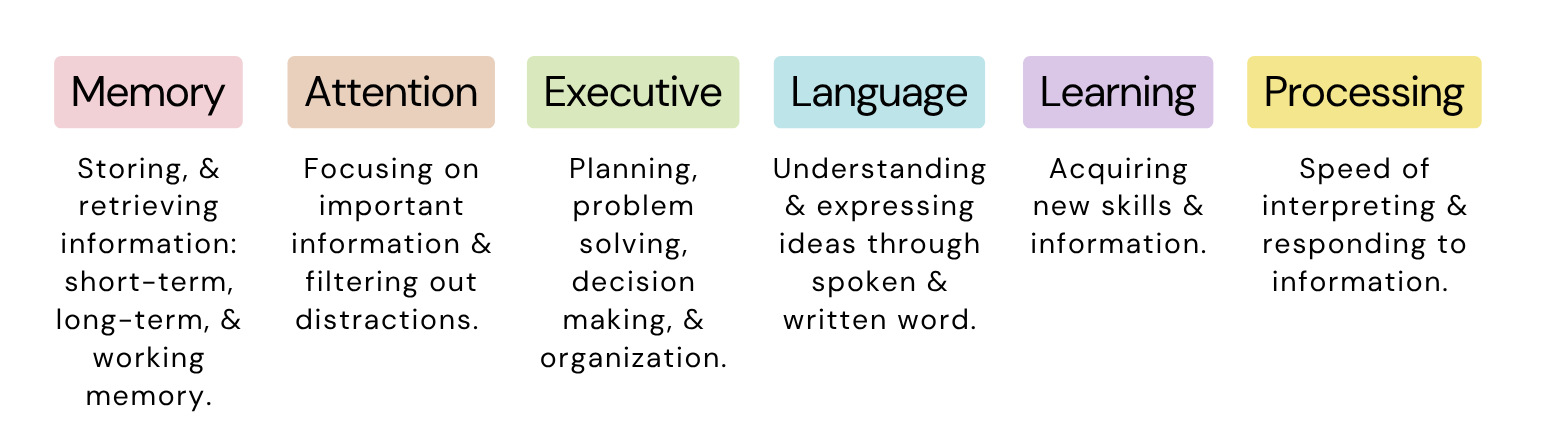
Yes, cognitive health includes memory, but it is waaaaaay more than memory.
It is identity.
It is independence.
Is Cognitive Decline Inevitable?
For the most part, no.
A little slowing of processing speed — recalling a name, following fast conversations, for example — may be part of the brain aging process. But this certainly doesn’t impede identity or independence.
Anything more than mild processing speed changes is cause for investigation because it suggests there may be some pathology in the brain, disrupting how it functions.
Pathology is a complex word that I’m going to over simplify as something in the brain that isn’t supposed to be there. In the case of Alzheimer’s disease, the pathology is accumulation amyloid-beta and tau-tangle proteins.
Understanding the basics of the pathology of cognitive decline can provide you with the information and inspiration you need to decrease the risk that the pathology accumulates in the first place.
The list of factors that can decrease pathology accumulation is growing. A 2024 publication in The Lancet included 14 well-researched factors to consider, and that list is expected to grow.
More on that next week in Part 2.
As always, thanks for being here,
~Allison
Please remember that this information is meant to educate and inspire but is not medical advise — please consult your healthcare team to determine what is most appropriate for you.
Thank you Alison. Just started reading and already am more at peace. Joan