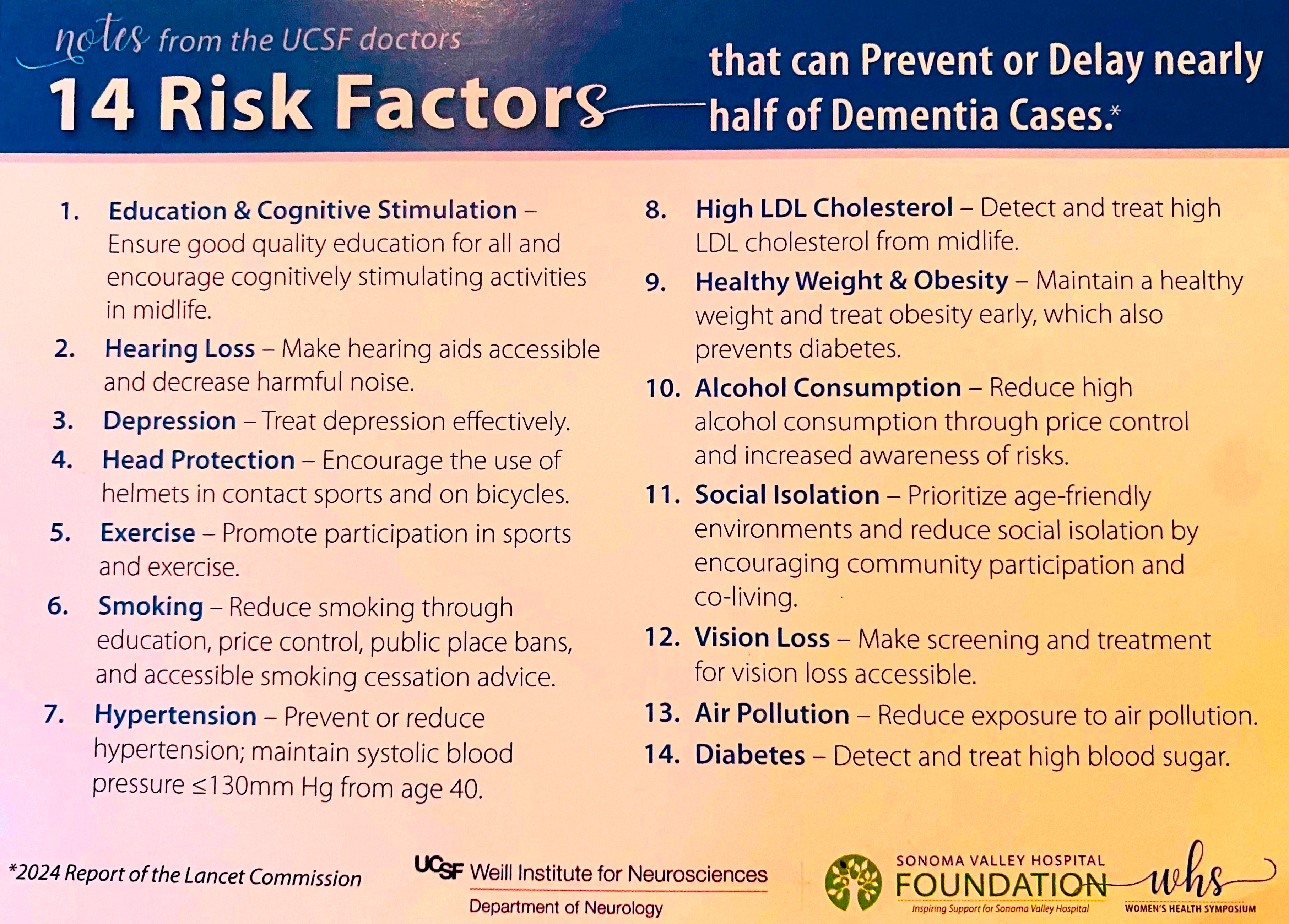
Half of this piece was written yesterday, before I attended the Women’s Health Symposium1 put on by Sonoma Valley Hospital Foundation in partnership with UCSF. To my surprise and delight, the neurologists and researchers talked about the same 14 risk factors that can prevent or delay the onset of dementia that I bring to you today.
Not long ago, an Alzheimer's diagnosis came with little more than advice to "get your affairs in order."
Those worried about their own risk had little guidance and even fewer concrete steps they could take to prevent the onset or progression of the disease.
I don’t blame science or medicine for this.
The brain is so complex. If back then we were in the infancy of understanding its complexities, then today we are mere adolescents.
We’ve come a long way, and we still have a way to go.
I have been lucky to have had a front-row seat to how far our understanding of Alzheimer's disease has come.
Back in 2016, while working at Sonoma Valley Hospital, I was asked to join a team with the Buck Institute to develop a program built around the emerging evidence that nutrition and lifestyle could play a meaningful role in preventing and slowing the progression of Alzheimer's disease.
I was a baby dietitian back then. I didn’t appreciate what a gift this opportunity was.
Nevertheless, I jumped headfirst into getting myself up to speed on Alzheimer’s disease research and haven’t slowed down since.
Over the years, I have learned that there is so much we can do to protect our brain health.
In fact, a 2024 Lancet Commission report estimated that 45% of all dementia diagnoses are due to modifiable causes, meaning things that you can monitor and address with your healthcare team.
This is huge!
In Part 1 of this series, I provided background about what cognitive health is and the most common causes of dementia (with Alzheimer’s disease leading the pack).
In Part 2, I explored the non-modifiable risk factors (age, genetics, and biological sex) and how these factors can work as motivators to understand and act on the many modifiable risk factors.
Today’s post is all about the modifiable risk factors. Oh, and by the way, these factors aren’t just good for your brain, they are good for your whole body:
Modifiable Risk Factors:
Level of education — While most research refers specifically to formal higher education, being a lifelong learner in any sense of the word can only help support your cognitive health. Take a class, join a book club, learn a language, pick up an instrument. Curiosity counts.
Traumatic brain injury (TBI) — Falls, car accidents, and sports are the leading causes of concussion and brain injury. While we can’t go back and change any history of brain injury, we can stay off of ladders, put handrails and anti-slip mats in the shower, and always wear seatbelts.
Elevated LDL-cholesterol — The adage “What is good for your heart is good for your brain” continues to hold true. It includes monitoring for and managing plaque-forming cholesterol. Talk with your doctor about whether the more aggressive LDL targets published recently apply to you.
High blood pressure (hypertension) — Working with your doctor to keep your blood pressure in a healthy range won’t just make them happy; it will protect your heart and brain.
Smoking — While smoking increases the risk of dementia, long-term cessation significantly lowers it. In fact, quitting in middle age or later and staying smoke-free may reduce dementia risk to that of a non-smoker after 8–10 years. It is never too late to quit.
Diabetes — Chronically high blood sugar damages the brain and may increase Alzheimer’s Disease-related pathology over time. Monitoring for and managing high blood sugar, prediabetes, and diabetes goes a long way in protecting your brain.
Excessive alcohol intake — "Excessive" is currently defined as more than 21 units of alcohol per week, compared to fewer than 14 units, with a 4–5oz glass of wine, 12oz beer, and 1–1.5oz of liquor each counting as one unit. That said, some research suggests there is "no safe level of alcohol consumption for dementia," especially for women and those carrying the high-risk APOE-4 gene.
Obesity — The number on the scale is my least favorite health metric, for it is often more harmful (to mental health) than helpful. That said, excess body weight, particularly around the midsection, is associated with increased risk for several chronic diseases, including dementia. If this applies to you, focusing on the lifestyle and medical strategies covered here is a more meaningful and comprehensive place to start.
Physical inactivity — Any movement is better than no movement (and it isn’t too late to start!) was a primary takeaway from the Women’s Health Symposium I attended yesterday. In fact, physical activity may be the most important factor in protecting your cognitive health, with regular movement being the key.
Depression — Appropriately treating depression and other mental health challenges, especially in midlife, is an important step in protecting long-term brain health. Seek support, whether through therapy, medication, lifestyle changes, or a combination. Your brain health is worth it.
Social isolation — Humans are wired for connection, and the brain thrives on meaningful social engagement. Chronic loneliness and isolation have been shown to accelerate cognitive decline. Prioritize your relationships, stay involved in your community, and don't underestimate the powerful protective effect of simply spending time with people you care about.
Hearing loss — Sensory input is essential for keeping the brain active and for maintaining and forming new brain cell connections. Untreated hearing loss not only reduces a critical sensory channel, but it is also often socially isolating, compounding the risk even further. Wear those hearing aids if you need them!
Vision loss — Untreated vision impairment can be socially isolating and may reduce engagement in cognitively stimulating activities such as reading, writing, and art. Stay current with regular eye exams, and let this be extra motivation to manage your blood sugar and blood pressure, both of which can also affect your vision.
Air Pollution — This risk factor is often considered a "social determinant of health," meaning that people of lower socioeconomic status are more likely to work and live in communities with higher levels of air pollution. Relocating away from polluted areas is not a realistic option for most, but it is worth acknowledging that chronic exposure to this environmental factor does play a role in long-term brain health.
Next week, I’ll share what we know about how dietary intake affects many of these risk factors, as well as the risk of cognitive decline.
In the meantime, I’d be honored if you shared this with someone you care about.
As always, thanks for being here,
~Allison
Please remember that this information is meant to educate and inspire, but is not medical advice. Please consult your healthcare team to determine what is most appropriate for you.
Confession: While I was looking forward to the speakers and mingling at the Women’s Health Symposium, I wasn’t sure what to expect with the boxed lunch that was included. Let’s just say that I couldn’t have planned the offerings better. No, it wasn’t a sandwich and a cookie. It was an array of healthy, hearty salads. Socks. Blown. Off.