

Did you hear? I launched a new podcast this month! Check out the Insight into Health podcast wherever you listen to podcasts (here are the links to Apple and Spotify).
This is Part 2 of my series all about sleep. In Part 1, I offered my thoughts on why sleep is so important, what “good” sleep actually means, and how to decide if sleep trackers are right for you.
Today, we’ll explore how sleep happens and what goes on while you are getting your zzz’s.
How Does Sleep Happen?
1. Melatonin
I’m guessing you’ve heard of melatonin. It is the most common sleep supplement in the US.
Many people don’t realize that melatonin is naturally produced in our brains to help us fall asleep, yet it has little value in keeping us asleep.
Naturally produced melatonin is light-dependent, a system that evolved when sunrise, daylight, and sunset were the main drivers of our sleep-wake cycle.
The amount of light coming into our eyes directs melatonin production:
As light increases (think sunrise), melatonin production goes down
As light decreases (think sunset), melatonin production goes up
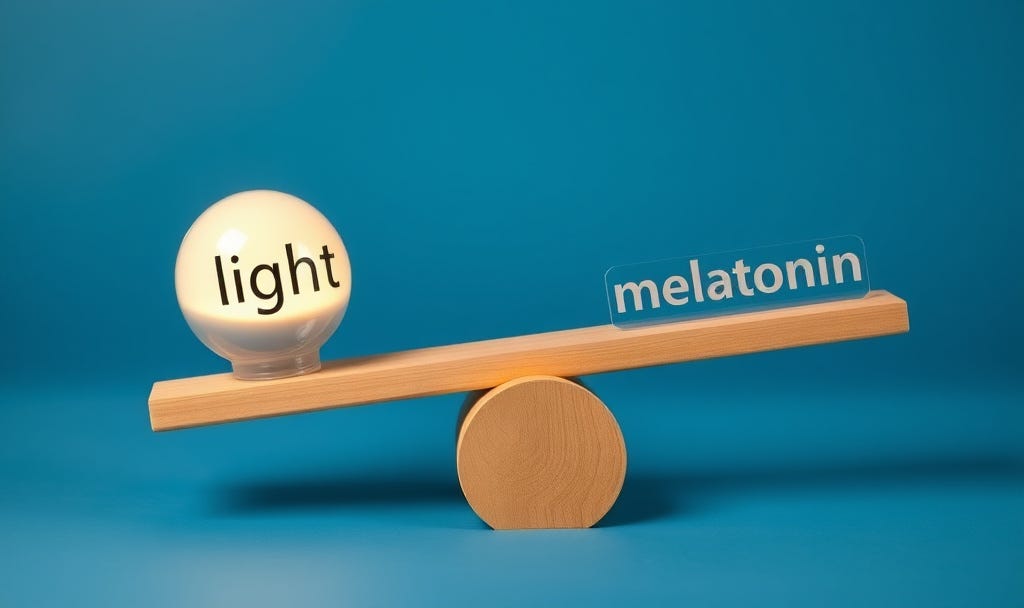
Disruptions to melatonin production because of artificial light exposure at night, such as lights in our homes and screens, and inadequate sunlight exposure during the day, are at the core of poor sleep for many.
2. Adenosine
Adenosine is the byproduct of energy metabolism (ATP for any biology folks out there). The longer you are awake, the more adenosine builds up in your brain. As the day goes on, adenosine slowly accumulates, which causes you to feel more tired. This is known as “sleep pressure.”
Getting a good night of sleep clears adenosine from the brain.
(Fun fact: Caffeine blocks your brain from recognizing that adenosine is there. That’s right, caffeine does not give you energy. It just tricks your body into not realizing how tired it is.)
Importantly, both adequate melatonin production and sleep pressure are required to fall asleep and stay asleep. Easier said than done, I know.
Your Hormones on Sleep
If you think that melatonin and adenosine are impressive/complicated/overwhelming…we are just getting started.
In Part 1 of this series, I shared that chronically poor sleep affects nearly every area of health: metabolic, cardiovascular, immune, mental, and more.
Why is that? How is sleep so powerful?
The answer has to do with more hormones. Hormones that follow sleep-wake cycles and are affected by poor sleep:
Cortisol is the “alert” hormone that gradually decreases throughout the day and spikes in the early morning to prepare for wakefulness. Poor sleep confuses cortisol production, often resulting in high levels at night, making it difficult to fall and stay asleep, and low levels in the morning, making it difficult to feel awake.
Leptin & Ghrelin are “appetite” hormones that play opposite roles. As leptin goes up after a meal, you feel full. On the other hand, ghrelin1 levels make you feel increasingly hungry the longer it’s been since a meal.
Insulin is the “energy shuttle” hormone, responsible for moving energy-rich blood glucose (blood “sugar”) from the bloodstream into the cells. Sleep deprivation makes insulin less effective, raising blood sugar and increasing the risk of Type 2 Diabetes and other metabolic-associated conditions.
Growth Hormone is the “repair” hormone, released during sleep to stimulate tissue repair, immune health, and metabolism. Poor sleep can impair recovery and healing.
I could go on, but I’ll spare you.
I hope that I have left you feeling a little bit more impressed by the role of sleep in your health.
Thanks for being here,
~Allison
P.S. Interested in listening to the Insight into Health podcast hosted by yours truly? New episodes are published every Wednesday (here are the links to Apple and Spotify).
Remember that this information is meant to educate and inspire, but is not medical advice. Please consult your healthcare team to determine what is most appropriate for you.
When I was in college and trying to keep all of these appetite hormones straight, I started thinking of grehlin as a hunger “gremlin” that yells until it gets what it wants. And this was before “hangry” became a thing, by the way.